As secondary educators, our work reaches far beyond academic standards. We know that emotion directly impacts cognition—a student who is overwhelmed by stress, personal dilemmas, or digital burnout simply cannot process complex literary analysis or advanced algebra.
While teachers have always been mindful of emotional well-being, supporting middle and high school students’ mental health and social-emotional development is more critical than ever. When we prioritize emotional maturity, stress management, and classroom culture, we create an environment where rigorous learning can actually happen.
Here is a look at why emotion drives learning, along with actionable ways to integrate Social-Emotional Learning (SEL) into your secondary classroom without sacrificing academic time
The Neuroscience: Why Emotion Drives Motivation and Learning
It isn’t just a intuition—brain science backs up the link between emotion and achievement. Research published in Frontiers in Psychology highlights that emotion heavily influences cognitive processes like attention, memory retention, and problem-solving.
When teens experience anxiety, fear, or persistent stress, their brains shift into survival mode, narrowing their attention span and hindering higher-order thinking. Conversely, positive emotional states and supportive classroom cultures heighten engagement and help students retain information long-term.
So, how can secondary teachers adapt instruction to support students emotionally while keeping academic expectations high?
1. Make Learning Culturally Relevant and Joyful
Emotional events are remembered far more clearly than neutral ones. You can leverage this in secondary classrooms by introducing curiosity, connection, and lightheartedness:
- Connect to Real-World Topics: Bring current, age-appropriate issues into class discussions or quick warm-up activities. Prioritizing depth over breadth (“an inch wide and a mile deep”) prevents students from feeling perpetually overwhelmed by fast-paced curriculums.
- Enhance Instruction with Active Inquiry: Boost student motivation by tapping into their natural curiosity and giving them hands-on roles in their learning. For example, during a novel study, replace traditional worksheets with an interactive simulation—like this Great Gatsby Car Accident CSI & Trial Simulation. In this close-reading inquiry activity, students take on roles like CSI workers, witnesses, and prosecutors to analyze textual evidence from Myrtle Wilson’s crash, examine real-world impaired driving laws, and make critical-thinking legal decisions.
- Incorporate Low-Stakes Engagement: A short video clip, a meme related to your content, or a bit of humor hooks secondary students immediately and lowers their affective filter.
- Build in Joyful Milestones: High school and middle school shouldn’t feel like a endless grind. Celebrate finishing a major unit or novel with an immersive experience—like hosting a “Roaring ’20s” gathering for The Great Gatsby or a tea party after reading To
 Kill a Mockingbird.
2. Weave Daily SEL Routines Into Your Curriculum
Secondary students need explicit, age-appropriate practice navigating conflict, time management, and real-world ethical dilemmas. However, finding time for dedicated SEL lessons in a departmentalized schedule can feel impossible. The most effective approach is establishing a consistent, low-prep warm-up routine.
Classroom Resource Spotlight
Looking for an easy way to build critical thinking and emotional maturity into your daily schedule?
Check out these Secondary SEL Bell Ringers and Task Cards in my Teachers Pay Teachers store!
Designed specifically for middle and high schoolers (no childish clip art here!), this comprehensive set features 80 prompts split into two core areas:
-
-
40 Problem-Solving Cards: Real-world logistics like tech glitches, academic overload, and time management.
-
40 Dilemma-Solving Cards: Character, ethics, digital drama, and peer pressure.
-
Each card pairs with a reusable 3-Step Action Plan Handout that teaches students how to pause, identify local support resources, and map out accountable solutions. Because responses require personal reflection and local resource mapping, this resource is completely AI-resistant—making it the ultimate low-prep routine for advisory periods, life skills units, or daily bell ringers!
3. Explicitly Teach Stress-Reduction and Coping Strategies
Teens carry immense pressure—from standardized testing to social media dynamics and post-secondary planning. Educators can help them build healthy coping mechanisms directly in the classroom:
-
Practice Controlled Breathing: Deep breathing activates the vagus nerve and triggers the parasympathetic nervous system, lowering heart rate and blood pressure. Taking two minutes for a quick guided breathing exercise (using tools like the Calm app) before a major exam can significantly reduce test anxiety.
-
Encourage Physical Movement: Exercise releases endorphins that reduce stress and improve focus. Build simple movement breaks into block periods, or encourage “writing walks” when students are brainstorming essay topics.
-
Model Positive Self-Talk: Secondary students are often their own harshest critics. Help them reframe negative thoughts by explicitly modeling self-compassion. If a student dismisses a good grade as “just luck,” challenge them to recognize their effective study habits instead.
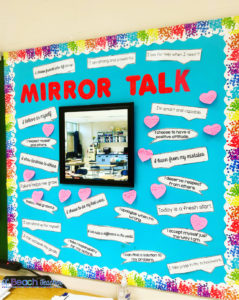
One simple way I introduced this in my own classroom was through a “Mirror Talk” bulletin board. I hung a mirror in the center surrounded by uplifting quotes, and then had students write their own positive self-talk statements on sticky notes to add around it. It gave them a physical, daily reminder to speak to themselves with kindness. When a student dismisses a good grade as “just luck,” challenge them to pause, look in that mirror, and recognize their effective study habits instead.
4. Prioritize Community and Connection
Social isolation and emotional distance are major sources of secondary student stress. Building a safe, highly connected classroom culture creates a protective barrier for student mental health, helping teens feel seen, heard, and supported.
While cooperative learning structures and group discussions are great for peer engagement, authentic writing is one of our most powerful tools for fostering true empathy. In a landscape dominated by standardized testing and rigid rubrics, it is easy to focus exclusively on analytical essays or persuasive prompts. However, when we give students opportunities to write for genuine audience and human expression, magic happens.
Writing reminds secondary students that they aren’t alone in their struggles—their stories bridge the gap between their unique backgrounds and shared human experiences. Giving teens space to share their voices builds deep classroom empathy and helps reluctant writers rediscover the joy of written communication.
Read More: For a deeper dive into balancing academic mandates with meaningful student voice, check out my post on Writing for Human Connection: Moving Beyond Tests and Rubrics.
Note: While teachers play a pivotal role in fostering well-being, always reach out to your school counselors, administration, and parents if a student exhibits signs of severe emotional distress or mental health crisis.
What strategies do you use to support SEL and mental health in your classroom?
How do you balance academic rigor with emotional support? I’d love to hear your favorite icebreakers, advisory routines, or warm-up strategies in the comments below!

References & Further Reading
-
André, Christophe. “Proper Breathing Brings Better Health.” Scientific American, 2019.
-
“Physical Activity Reduces Stress.” Anxiety and Depression Association of America (ADAA).
-
Tyng, C. M., et al. “The Influences of Emotion on Learning and Memory.” Frontiers in Psychology, 2017