1. Hook Students with the Ethics of Science & AI
Start the unit by placing Mary Shelley’s core question front and center:
What are the consequences of man’s interference with nature, and what responsibility do creators have toward their creations?
Before diving into the text, have students explore modern connections to build context:
AI & Digital Consciousness: Ask students to consider modern artificial intelligence. What responsibilities do developers have when building systems that mimic human thought? Could AI become a tool for harm if left unregulated?
Scientific Hubris & Bioethics: Have students find recent news articles (using websites like Newsela or Science News Explores) about gene editing (CRISPR), organoids, or medical advancements to debate where the line between innovation and hubris sits.
Creator Responsibility & Abandonment: Ponder what happens after a breakthrough occurs. Once a technology or synthetic creation exists, does the creator have an ongoing moral duty to care for, guide, or control it?
Build Daily Argumentative Habits with CER Bell Ringers: To transition these big ethical debates into structured writing, start class each day with quick Argumentative Writing Bell Ringers. Using the Claim, Evidence, and Reasoning (CER) framework, these daily warm-ups push students to evaluate evidence, anticipate counterarguments, and write quick refutations on high-interest, real-world topics.
While the resource comes packed with 60 adolescent-friendly prompts (covering everything from drones, to TikTok, to AI technology), you can also use the included blank template to drop in custom Frankenstein-themed claims! Warm up their brains each morning with prompts like “Tech companies should be legally responsible for the actions of their AI creations” or “Scientific progress should be limited by ethical boundary laws.” It’s a low-prep way to build the exact persuasive muscles students will need for their final unit essay.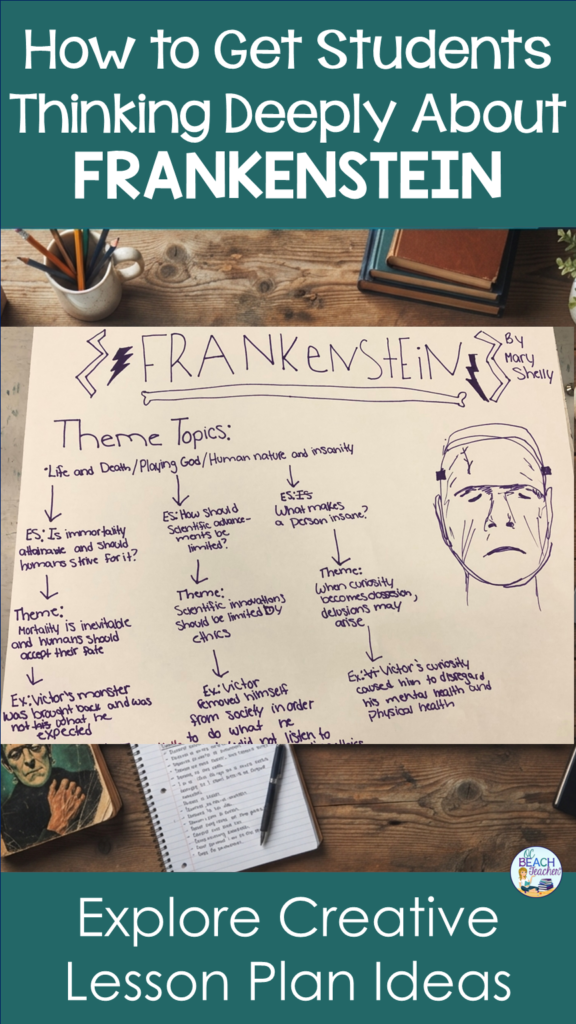
2. Shift from “Monster” Stereotypes to the Empathy Question
High school students often come to class expecting a classic movie monster. One of the most rewarding shifts in teaching Frankenstein is helping them realize that Victor’s abandonment is what truly creates the tragedy.
Before tackling a complex novel, it can be incredibly helpful to practice core close-reading skills on shorter texts first. Having students examine character, conflict, and theme using hands-on short story graphic organizers builds the analytical confidence and quote-framing skills they need to tackle dense 19th-century literature.
Once students are ready to dive into Shelley’s text, focus close-reading instruction on the Creature’s pivotal speeches to explore nature vs. nurture, isolation, and parental responsibility
In Chapter 10, the Creature confronts Victor on the Mer de Glace with a powerful plea:
“Remember that I am thy creature; I ought to be thy Adam, but I am rather the fallen angel, whom thou drivest from joy for no misdeed. Everywhere I see bliss, from which I alone am irrevocably excluded. I was benevolent and good; misery made me a fiend. Make me happy, and I shall again be virtuous.”
Later in Chapter 15, he directly addresses Victor’s neglect by contrasting his existence with biblical creation:
“Like Adam, I was apparently united by no link to any other being in existence… He had come forth from the hands of God a perfect creature, happy and prosperous, guarded by the especial care of his Creator… but I was wretched, helpless, and alone.”
Posing the central question—Who is the real monster?—drives deep analytical writing and pushes students to evaluate how a lack of human connection and empathy corrupts morality.
3. Energize Analysis with Active Learning
Because Frankenstein is dense with frame narratives, epistolary formats, and heavy imagery, incorporating hands-on activities keeps student engagement high throughout the reading process.
- Start with a Hands-On Hook: On day one, run a “What is a Monster?” introduction activity. Have students sketch, use playdough, or use digital apps to create a monster, then write a short description defining what makes something monstrous. By the end of the novel, revisit these initial creations so students can realize the irony of Victor being the true monster of the narrative.
- Step into the Role of Literary Detectives: Before diving into Chapter 1, get students up, moving, and actively making logical inferences with a pre-reading Frankenstein “Detectives” Anticipation Activity. In this close-reading exercise, 30 key lines from Shelley’s text are distributed to students. Armed with a note-catcher, students travel around the classroom as literary detectives, analyzing textual evidence to make predictions about the plot, characters, and thematic elements before opening the book. It’s an easy, low-prep way to spark immediate curiosity and build context.
- Trace Literary Allusions: Assign small student groups to research key allusions (such as Greek mythology’s Prometheus, Milton’s Paradise Lost, or Coleridge’s Rime of the Ancient Mariner) and present them via a jigsaw format so the entire class builds an allusion guide.
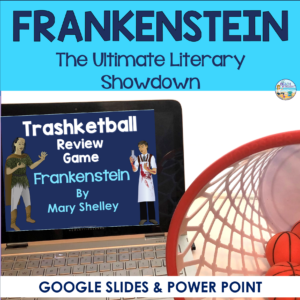
- Review with High-Energy Games: When preparing for unit exams or AP-style open essay prompts (Q3), move away from traditional review sheets. Using an active review game—like a whole-class Trashketball review game focused on textual evidence and character quotes—keeps students motivated, competitive, and accountable for citing strong evidence.
Teacher Resource Tip: If you want an easy, low-prep way to review key characters, plot points, and quotes before your final assessment, check out my Frankenstein Trashketball Review Game to get your entire class up and moving while mastering text evidence!
4. Wrap-Up & Assessment: Comparative Texts & Synthesis
Concluding your Frankenstein unit with comparative texts allows students to meet standard RL.11-12.7 by evaluating how different creators across time and mediums interpret, adapt, and transform Shelley’s core motifs—such as the ethics of creation, the duty of a creator, and the pain of isolation.
Literary & Sci-Fi Pairings (Artificial Life & Playing God)
Pair excerpts of Frankenstein with contemporary and classic works that explore the responsibilities of creation and the consequences of scientific hubris:
- Novel: Kazuo Ishiguro’s Klara and the Sun or Never Let Me Go, and Neal Shusterman’s Unwind, which challenge students to define humanity, moral obligation, and the ethics of technology.
- Classic Short Stories:
- Nathaniel Hawthorne’s “The Birthmark”: A powerful parallel to Victor Frankenstein’s obsession with natural perfection, control, and the dangerous pursuit of playing God.
- Ray Bradbury’s “The Veldt”: Explores creation turning on its creators, examining how technology displaces parental responsibility and nurtures alienation.
Parental Duty & Relational Isolation (Poetic Pairings)
To deepen discussion around Victor’s abandonment of the Creature, pair key chapters with poetry focusing on the complexities of parent-child dynamics and existential solitude:
- Parent-Child Dynamics:
- “Shoulders” by Naomi Shihab Nye: Highlights the absolute duty, tenderness, and protection a parent owes a vulnerable child—contrasting sharply with Victor’s immediate rejection.
- “Those Winter Sundays” by Robert Hayden & “My Papa’s Waltz” by Theodore Roethke: Examine the nuanced, non-idealized, and often unspoken tensions between fathers and children, grounding Victor and the Creature’s dynamic in realistic emotional friction.
- Existential Solitude:
- “Alone” by Edgar Allan Poe: Complements the Creature’s internal monologue and origin story, illustrating how early emotional isolation permanently shapes an identity.
- “A Desolation” by Allen Ginsberg: Ginsberg reflects on an inescapable, crushing sense of isolation despite being surrounded by the world. It echoes the Creature’s anguish as he observes human families from the shadows of the hovel, realizing he can never truly join them.
Cinematic & Popular Culture Adaptations
Analyzing visual media helps students evaluate how directors translate literary themes into visual and narrative choices across genres:
- Guillermo del Toro’s Adaptation: Compare Shelley’s original text with modern cinematic interpretations to analyze how film directors translate the Creature’s physical appearance, tragic nuance, and emotional depth for modern audiences.
- Michael Crichton’s / Steven Spielberg’s Jurassic Park: Provides an accessible, high-impact blockbusting pairing exploring hubris and chaotic consequences. Students can analyze how Hammond’s “spared no expense” scientific ambition directly mirrors Victor Frankenstein’s disregard for the long-term ramifications of “bringing life” into the world.
Whether you assess these comparisons through an AP Literature Open Question (Q3) timed essay, a mock trial of Victor Frankenstein or the Creature, or an ethical debate project on modern technology, these pairings ensure students evaluate Shelley’s themes beyond the final page.