Every October, the National Council of Teachers of English (NCTE) sponsors the National Day on Writing, encouraging educators and students nationwide to share their answers to a simple question using #WhyIWrite: Why do you write?
While this social media campaign offers a great opportunity for reflection, it often highlights a frustrating reality in the English Language Arts (ELA) classroom. When asked why they write, reluctant writers often give brutally honest answers: “Because I have to” or “To pass English.”
If these responses sound familiar, it may be time to shift focus from mechanical test preparation toward writing for human connection.
Why Writing for Human Connection Matters in the ELA Classroom
Standardized tests and strict curriculum requirements often limit writing instruction to rigid analytical essays, persuasive prompts, and formal research papers. While these skills are necessary, neglecting authentic self-expression leaves students feeling disconnected from their own voices.
Writing for human connection serves a fundamental purpose:
- Builds Empathy: Shares human experiences across diverse backgrounds.
- Fosters Belonging: Reminds students that their voices, thoughts, and feelings matter.
- Increases Engagement: Gives reluctant writers a meaningful reason to participate beyond earning a grade
4 Practical Strategies to Promote Authentic Student Writing
1. Low-Stakes Daily Journaling
As Flannery O’Connor famously noted, “I write because I don’t know what I think until I read what I say.” Regular, informal journaling gives students that exact space—a low-pressure sandbox to discover their own thoughts without worrying about formal conventions.
For Students: Keeping It Low-Burdensome
- Timed “Quick Writes” (3–5 Minutes): Set a visible timer. Tell students their goal is continuous writing without lifting the pen or pausing to erase. Short, structured time bounds eliminate the pressure of producing a long essay.
- Varied Multimodal Options: Not every entry needs to be prose. Let students choose from list-building, letter-writing to an imaginary recipient, sketch-and-label (mind maps/doodles with captions), or responding to music/visual prompts.
- Low-Stakes Entry Points (“Sentence Starters”): Offer optional jumpstart lines for students stuck in silent stare-down with a blank page (e.g., “Right now, I am thinking about…”, “One thing no one understands about…”).
For Teachers: Keeping Grading & Management Sustainable
- The “Student Choice” Audit (Batch Grading): Have students keep all entries in a dedicated notebook or digital folder. At the end of a unit or marking period, ask them to select 1 or 2 entries to submit for teacher feedback or formal grading, while the rest are marked purely for completion.
- Sticker / Stamp System: Walk around during the quick-write window with a stamp or quick checkmark stamp. This gives immediate validation that the student engaged with the prompt without requiring you to take notebooks home.
- Self-Reflective Checks: Once a week, instead of grading, have students read back over their past entries and write a 1-sentence reflection on what theme or pattern they noticed in their own writing.
Pro Tip: Use Background Music to Set the Tone
Playing soft background music during journaling creates a “sound blanket” that lowers anxiety and masks classroom fidgeting. A popular option is playing YouTube ambience videos—such as scenic nature soundscapes, rainy forest views, or cozy cabin backgrounds paired with soft instrumental music or Lo-Fi beats. The calm visuals give students a peaceful focus point without distracting them with lyrics. Keep the volume low and offer a quiet seating area for students who prefer total silence.
2. Choice Boards and Writing Menus
Giving students agency over what and how they write is one of the most effective ways to boost buy-in from reluctant writers. By utilizing writing menus or choice boards, you can easily align assignments with Common Core State Standards (CCSS) while still granting students creative freedom and autonomy.
A well-crafted choice board allows students to choose from various modes of writing—such as informational, argumentative, narrative, and creative—ensuring core literacy standards are met regardless of which path they select. Incorporating digital tools further expands these options, letting students leverage technology to express their ideas.
For example, after reading an excerpt from Henry David Thoreau’s Walden, students could choose from a menu of activities across different modes:
- Informational: Research and write a short report on the modern Tiny House Movement, examining how contemporary living reflects Thoreau’s ideas on simplicity.
- Argumentative: Draft a persuasive opinion piece on whether it is possible—or desirable—for a teenager to “unplug” from technology for a week in today’s society.
- Narrative: Write a personal reflection detailing a time you spent isolated in nature, focusing on sensory details and internal monologue.
- Creative & Digital: Create an imaginary diary entry or record a podcast episode from Thoreau’s perspective as if he were living in current society using digital tools like Google Slides, Canva, or audio recording apps.
Built-In Differentiation
Choice boards naturally lend themselves to differentiated instruction without singling students out:
- By Modality & Interest: Visual, auditory, and kinesthetic learners can select formats that suit their strengths (e.g., creating a digital infographic vs. writing a traditional essay).
- By Complexity & Scaffolding: You can tier prompts by depth or provide optional sentence frames, graphic organizers, and templates for students who need extra support, while offering extension challenges for advanced writers.
- By Output & Length: Adjust expectations based on student needs while keeping the core objective—engaging meaningfully with the text and concept—the same for everyone.
3. Real Audience Sharing
Students write with far more purpose, effort, and care when their audience extends beyond a teacher with a red pen. Creating opportunities for students to share their work transforms writing from an isolated classroom chore into a meaningful form of communication.
To build authentic connections, consider sharing student writing across three distinct spheres:
Peer-to-Peer Collaborations
While sharing within the classroom is valuable, reaching beyond your own room adds an exciting layer of real-world authenticity:
- Inter-Class Writing Exchanges: Partner with another teacher in your school—or even a classroom in another school district—to swap writing samples. Students can read a peer’s work, leave constructive feedback on sticky notes, or exchange digital letters/blogs.
- Vertical Articulation (Cross-Grade Sharing): Have your secondary students write stories or informative pieces designed specifically for younger elementary or middle school students, then arrange a reading session (in person or via video call).
- Low-Pressure In-Class Outlets: Utilize low-stakes sharing techniques like pair-shares, small group “writer’s circles,” or silent gallery walks where students leave positive comments on posted work.
Family & Local Community Connections
Bringing student voices to their immediate community makes writing feel personal and impactful:
- Family Keepsakes & Letters: Have students draft interviews, memoirs, or persuasive letters addressed to parents, grandparents, or guardians. Sharing these at home bridges the gap between classroom learning and home life.
- Local Community Displays: Partner with local public libraries, senior centers, or community coffee shops to showcase student poetry, short stories, or essays.
- Local Publications: Encourage students to submit letters to the editor for local newspapers or write articles highlighting community events.
External & Digital Publishing
Expanding your audience globally gives students a platform to see their ideas make a real-world splash:
- Student Writing Contests: Offer enrichment points or dedicated class time for entering reputable student contests, such as The New York Times Learning Network challenges or local humanities contests.
- Digital Platforms: Utilize interactive tools like Padlet, digital literary magazines, or classroom blogs (with appropriate privacy settings) so students can publish their work for an authentic digital audience.
4. Write Alongside Your Students
One of the most powerful shifts you can make in your classroom culture is moving from being a supervisor of writing to a fellow writer. Modeling the writing process—including the struggle, messiness, and self-doubt—normalizes the reality that writing is hard work for everyone, not just for students.
Model the Reality of Writer’s Block
When teachers only present finished, polished models, students often assume good writers produce great work effortlessly on the first try. Writing alongside your class breaks down this myth:
- Overcoming the Blank Page Together: Participate in the same quick-writes, journal prompts, or choice board activities you assign. Let students see you hesitate, draft, erase, and rethink your words in real time.
- Sharing Personal Vulnerability: Experiencing writer’s block is normal. Sharing your own struggles—whether it’s getting stuck on a creative project, a memoir, or finding the right word—reminds students that perseverance is part of the creative process.
Empower Students as Authors Who Can Change the World
Beyond skill-building, writing gives students a vehicle to process their world and advocate for change.
- Treat Students as True “Authors”: Refer to your students as authors and celebrate the ideas they express. Simple shifts in vocabulary elevate their self-perception and encourage them to take pride in their craft.
- Focus on Impact & Purpose: Remind students that their ideas matter far beyond the classroom walls. Whether they are writing about a community issue, a personal experience, or a passion project, reinforce the notion that a well-crafted message can inspire empathy, provoke thought, and create positive change.
- Provide Low-Risk Speaking Outlets: Build student confidence by giving them opportunities to perform or record their writing. Offer enrichment points or low-stakes recognition for students who read their work aloud to the class, record an audio/video reading usi
 ng tools like Flip, or present their ideas in digital showcases.
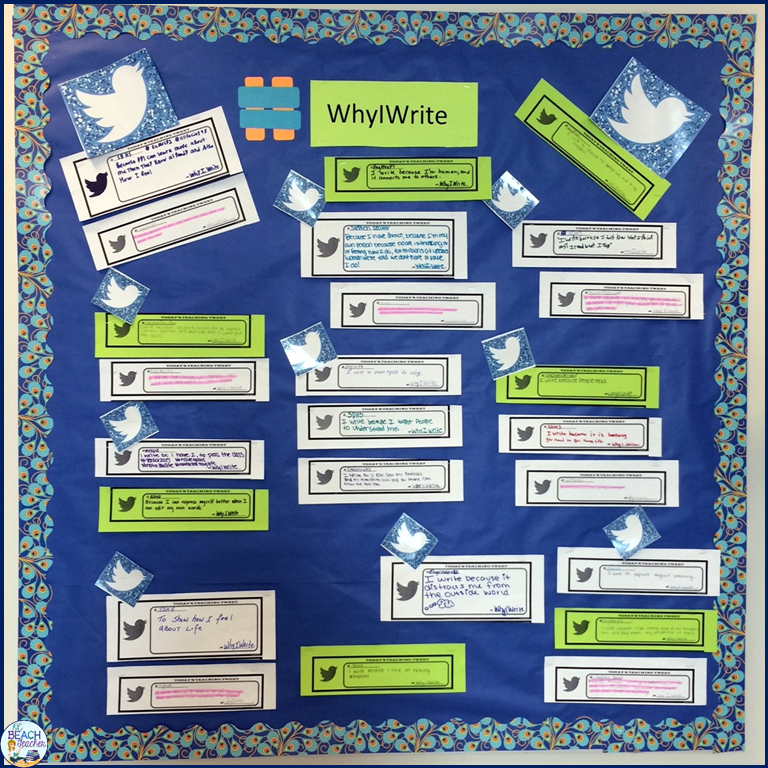
Putting It into Practice: The #WhyIWrite Bulletin Board Activity
How to Run the Activity Step-by-Step
- Set the Stage: Introduce the National Council of Teachers of English (NCTE) #WhyIWrite campaign. Frame writing as a universal tool for human connection rather than just a school requirement.
- Distribute “Tweet” Slips or Digital Cards: Provide students with printable exit slips formatted like social media posts, complete with space for a short response and the hashtag #WhyIWrite.
- Grant Explicit Permission for Honesty: Reassure students that authentic answers are welcome—even if they feel reluctant about writing. When students realize they won’t be penalized for writing “because I’m forced to” or “to pass English,” it opens the door to honest dialogue about why school writing often feels disconnecting.
- Publish & Display: Have students pin their physical slips to a designated classroom bulletin board (using fun clip art or border trim) or post them onto a shared digital board using tools like Padlet or Google Slides.
- Debrief as a Community: Use the collective display as a launchpad for a class discussion. Acknowledge the pragmatic answers, celebrate the heartfelt ones, and discuss how your class can move toward writing that feels more personal, meaningful, and connected.
Cultivating Authentic Voice in the Age of AI
In an era where AI text generators are readily available, reluctant writers often turn to digital tools when assignments feel rigid, transactional, or disconnected from their real lives. However, when writing instruction is grounded in personal connection, authentic reflection, and real-world sharing, the motivation to shortcut the writing process disappears.
AI can synthesize information and structure essays, but it cannot replicate a student’s lived experiences, unique perspective, or genuine emotion. By focusing on low-stakes journaling, student choice, real audience sharing, and teacher modeling, we teach students to value their own thinking. In doing so, we help them develop the critical reasoning skills and confidence needed to cultivate a personal voice that no algorithm can generate.
When we shift our classroom focus from rigid mechanics and high-stakes test prep to authentic self-expression, writing transforms from an obligation into a bridge. By providing low-stakes journaling opportunities, offering meaningful choices, creating real audiences, and writing alongside our students, we do more than just build stronger ELA skills and combat AI reliance—we empower reluctant writers to realize that their voices have value, their stories matter, and their words truly can connect with the world around them.
How do you help your students write for human connection and discover their authentic voices? Share your favorite strategies and lessons in the comments below!